
TL;DR:
- Most small businesses view SEO as a technical task, but combining it with digital PR builds authority and trust. Digital PR earns genuine media coverage and backlinks that improve search visibility, signals Google recognizes as credible. Effective campaigns use original data, expert insights, and newsworthy stories to secure reputable mentions, boosting SEO and long-term brand authority.
Most small business owners treat SEO as a purely technical exercise: fix the website, target the right keywords, build some links, and wait. But that approach only goes so far. The businesses gaining real ground in search results today are the ones combining traditional optimization with digital PR, earning mentions in reputable publications, getting quoted as industry experts, and building authority signals that Google genuinely trusts. This guide walks you through exactly how digital PR works, why it matters for your SEO, and the practical steps you can take to start building that authority right now.
Table of Contents
- Defining digital PR and its relationship with SEO
- How digital PR builds authority and earns trusted backlinks
- Tactics: Planning digital PR campaigns that earn coverage and results
- Measuring the impact: Linking digital PR outcomes to SEO wins
- Avoiding spam and maximizing ethical PR for SEO
- The overlooked power of digital PR: Why most small businesses miss out
- Level up your business visibility with proven SEO and PR strategies
- Frequently asked questions
Key Takeaways
| Point | Details |
|---|---|
| Editorial mentions drive SEO | Digital PR earns quality coverage and backlinks that boost your authority and rankings. |
| E-E-A-T is crucial | Press mentions and third-party validation build trust with search engines beyond link counts. |
| Plan newsworthy campaigns | Successful PR assets start with expert input, unique data, or timely angles journalists want. |
| Measure all outcomes | Track both linked and unlinked brand mentions to see true SEO impact from PR. |
| Avoid manipulative tactics | Earned mentions outperform paid links and protect your site from Google penalties. |
Defining digital PR and its relationship with SEO
Digital PR is the practice of coordinating your online media exposure specifically to support your search marketing goals. It is not just sending press releases or hoping a journalist finds you interesting. It means creating content, stories, and assets that earn you coverage on trusted websites, publications, and industry blogs, which in turn generates the editorial backlinks and brand mentions that strengthen your search presence.
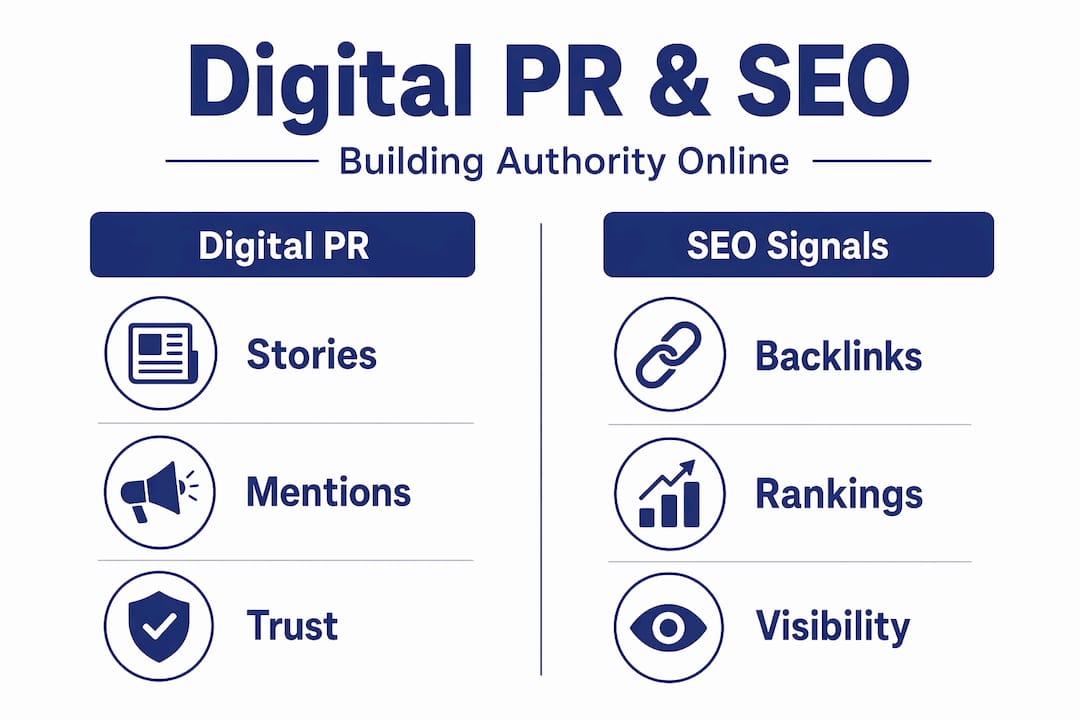
Digital PR supports SEO by earning editorial backlinks and brand mentions that improve search visibility and authority signals. These are the kinds of signals that keyword targeting and on-page tweaks simply cannot manufacture on their own.
Here is how digital PR differs from what most small businesses are currently doing:
- Traditional PR focuses on offline reputation, broadcast media, and press events. The goal is brand awareness, not search rankings.
- Link-building schemes try to acquire as many backlinks as possible, often through directories, blog networks, or paid placements. Google has heavily penalized these approaches.
- Digital PR earns coverage through genuinely newsworthy content and expert positioning. The backlinks and mentions that result are organic, editorial, and far more valuable to search engines.
“The best links you can earn are the ones you never had to ask for twice because the story was simply too good to ignore.”
Google’s ranking systems reward what’s called E-E-A-T: experience, expertise, authoritativeness, and trustworthiness. Digital PR directly feeds those signals by placing your name and brand in front of journalists, editors, and readers who then reference and cite you. When a regional news outlet features your expert opinion, or a national industry blog links to your original data, that tells Google something paid tactics never can: that real people with real audiences consider you a credible source.
Consider how content marketing supports SEO in a similar way. Quality content and digital PR work together, one creating the asset, the other amplifying it to audiences that matter.
How digital PR builds authority and earns trusted backlinks
With a firm grasp of digital PR’s connection to SEO, let’s explore how it uniquely builds the authority signals search engines reward today.

Not all backlinks are equal. A single link from a well-known regional news site carries dramatically more weight than fifty links from generic blog directories. That is because editorial links signal genuine endorsement. A journalist or editor chose to reference you because your information was useful, credible, or newsworthy, not because you paid them or submitted your URL to a list.
E-E-A-T for SEO is built through third-party validation via coverage and reputable references, not simply link quantity. This is a critical distinction. Google has spent years refining its ability to detect manipulative link patterns. What it rewards instead is a pattern of natural, earned citation that mirrors how credibility works in the real world.
Here is a comparison of how editorial links from digital PR stack up against typical link-building approaches:
| Factor | Editorial PR links | Standard link building |
|---|---|---|
| Source quality | High-authority publications | Varies widely, often low |
| Editorial control | Journalist or editor decides | Often self-placed |
| Google trust signal | Strong | Weak to moderate |
| Risk of penalty | Very low | Moderate to high |
| E-E-A-T contribution | Direct and meaningful | Minimal |
| Longevity | Permanent and compounding | Often short-lived |
What makes digital PR assets compelling to journalists? Three things work consistently well:
- Original data or research — Reporters love citing statistics they cannot find elsewhere. A small business survey, a local market study, or an analysis of industry trends gives them something genuinely new to write about.
- Expert commentary — Being the person a journalist calls when they need an industry opinion is enormously valuable. This status is earned through consistent, helpful outreach over time.
- Newsworthy stories — Tying your business angle to a trend, local event, or wider cultural moment gives journalists a reason to cover you right now.
“One placement in a publication your ideal customer actually reads is worth more than twenty links on websites neither of them have ever seen.”
Pro Tip: When pitching journalists, make their job easy. Lead with the story angle, not your business name. Include a clear data point or unique insight in the first two sentences of your pitch. Journalists are busy, and a well-framed hook in the opening line dramatically increases your chances of a reply.
Understanding how SEO and AI strategies are evolving makes this even clearer. As AI-powered search platforms increasingly pull answers from trusted, well-cited sources, digital PR becomes the mechanism that gets you into those trusted circles.
Tactics: Planning digital PR campaigns that earn coverage and results
Understanding the mechanics is good, but applying them is where small businesses can really shine. Here is how to approach digital PR as a repeatable process.
A strong digital PR campaign follows a clear sequence. Data-driven content and expert input are the core assets journalists will cite and link to. Here is how to build a campaign from scratch:
- Identify your story angle. What does your business know that others do not? What local or industry data can you gather and analyze? Start with what is genuinely interesting to people outside your company.
- Research your target publications. Find the journalists, bloggers, and editors who cover your industry or local market. Study their recent articles to understand what angles resonate with them.
- Create your PR asset. This could be an original study, a visual infographic, a detailed expert guide, or a timely response to a trending news story, what is sometimes called “newsjacking.”
- Craft a targeted pitch. Write a short, direct email that leads with the story angle, not a sales message. Explain why their audience will care, and include your key data point or insight immediately.
- Follow up once. A single follow-up after five to seven business days is appropriate. More than that risks damaging the relationship.
- Track and document coverage. Every piece of coverage is a search asset. Record the publication name, URL, and whether it includes a backlink.
When it comes to writing engaging content for SEO, the same principles that make content valuable to readers also make it valuable to journalists: clarity, originality, and a concrete point of view.
Your pitch preparation checklist should cover:
- A compelling, one-sentence story angle
- At least one original statistic or exclusive insight
- A clear connection to a current trend or news hook
- Your credentials as the expert source
- A short bio or company description for reference
Pro Tip: Stay firmly in earned-coverage territory. Avoid any arrangement where links are exchanged for money or reciprocal benefits. Paid placements that pass ranking signals violate Google’s guidelines and can result in manual penalties that are genuinely painful to recover from. The risks are never worth it, especially when the ethical path produces better long-term results anyway. You can also stay ahead of best practices by updating your SEO tactics as the landscape evolves.
Measuring the impact: Linking digital PR outcomes to SEO wins
Any smart campaign needs measurement. Let’s see how to tie PR efforts to the results that matter in SEO.
One common frustration with digital PR is that the results can feel hard to quantify. But with the right metrics in place, you can draw a straight line from a media placement to improvements in your search performance. Digital PR workflows increasingly track both linked and unlinked coverage and connect these directly to SEO outcomes.
Here are the key performance indicators every small business should track:
| KPI | What it measures | Why it matters |
|---|---|---|
| Referring domains gained | New sites linking to you | Directly impacts domain authority |
| Coverage volume | Number of media placements | Indicates PR campaign reach |
| Unlinked brand mentions | Times your brand is cited without a link | Contributes to E-E-A-T signals |
| Keyword ranking changes | Movements in target search terms | Reflects SEO impact of authority gains |
| Organic traffic growth | Visitors from search engines | Shows real-world business impact |
Unlinked brand mentions deserve special attention. When a journalist mentions your business name in an article without linking to your site, it still registers as a trust signal in Google’s assessment of your brand. These mentions are worth tracking in tools like Google Alerts or similar brand monitoring platforms. Over time, you can also reach out to authors and request a link be added, converting a mention into a backlink.
- Set up Google Alerts for your business name and key spokesperson names
- Review referring domain counts in your preferred SEO tool monthly
- Compare keyword ranking snapshots before and after major coverage events
- Track direct traffic spikes that align with publication dates
Understanding SEO algorithm changes and strategy helps you interpret these metrics accurately. A jump in rankings following a major media placement is rarely coincidental. Authority compounds over time, meaning each new trusted citation reinforces the ones before it.
Avoiding spam and maximizing ethical PR for SEO
To finish, let’s clarify what to avoid so your PR efforts grow rankings and brand credibility, and never risk penalties.
Google is explicit: earned links and mentions should result from editorial coverage, not paid placements designed to pass ranking signals. The distinction matters because the consequences of getting it wrong can set your SEO back by months or even years.
Here are the most common mistakes small businesses make:
- Buying links through “sponsored content” without disclosure. If money changed hands for a link, it must be labeled as sponsored. An unlabeled paid link is a policy violation.
- Using private blog networks. These are sites created purely to link to other sites. Google identifies and discounts them regularly, and sites that use them risk algorithmic or manual penalties.
- Over-optimizing anchor text. When every earned mention uses exactly the same keyword-rich anchor text, it looks unnatural. Let journalists link how they naturally would.
- Mass-submitting press releases with keyword-stuffed links. Press release distribution still has value for visibility, but links within press releases should use “nofollow” or “sponsored” attributes.
- Ignoring link quality for link quantity. Ten links from obscure sites rarely help and can occasionally hurt if the sites are considered low-quality by Google’s standards.
“The safest link-building strategy is also the most effective one: earn the coverage, and the links will follow naturally.”
Pro Tip: Before pursuing any coverage opportunity, ask yourself whether the placement would make sense even without the link. If the only reason to pursue it is for the backlink, that is a warning sign. Legitimate digital PR creates genuine brand value first, and SEO benefits as a natural result.
Your ethical PR checklist for small businesses:
- Focus pitches on genuinely newsworthy content, not promotional announcements
- Never pay for links or offer reciprocal benefits in exchange for coverage
- Always disclose any commercial relationships when relevant
- Build relationships with journalists over time rather than treating each pitch as transactional
- Prioritize publications your actual target customers read
Learning to balance your acquisition strategies through paid vs. organic SEO gives you the full picture of where each tactic fits.
The overlooked power of digital PR: Why most small businesses miss out
Having covered what to do and what to avoid, here is an honest reflection on what actually moves the SEO needle with PR.
Most small businesses delay digital PR indefinitely. They tell themselves they will focus on it “once the website is ready” or “after we grow a bit more.” Meanwhile, they pour budgets into ads, fiddle with meta tags, and wonder why their rankings plateau. This is the pattern we see again and again, and it is worth being direct about it.
The uncomfortable truth is that website-level SEO gets you to a ceiling fairly quickly. On-page factors, site speed, and keyword targeting are necessary, but they are also easy for competitors to replicate. What is genuinely hard to replicate is the media authority you build over time through consistent, quality coverage.
Here is the unconventional insight most guides skip: you do not need a large PR budget to start. One well-pitched story, built around something your business genuinely knows, can land coverage in a respected regional or industry publication. That single placement can do more for your authority than months of technical tweaks. Start small, start focused, and build outward from that base.
Another thing most guides ignore is the value of unlinked mentions. Brand mentions without links still contribute to how Google perceives your authority. Tracking them through content marketing for SEO results alongside your link-building tells a more complete story of your brand’s growing presence.
Treat every media win as a permanent search asset. Share the coverage on your website, reference it in future pitches, and build on it. The businesses that win at local and national SEO over the long term are not the ones with the most complex strategies. They are the ones that consistently show up in places their audience trusts.
Level up your business visibility with proven SEO and PR strategies
Ready to move from learning to doing? Here is how you can apply these strategies today with expert help or guided resources.
At Battle SEO, our Local Command Directive™ framework is built around exactly the kind of authority-building this article describes. Digital PR is one of the core pillars, alongside Google Business Profile optimization, citation building, and on-page SEO, because we know that durable rankings come from being recognized as the dominant local authority in your niche.
If you are ready to boost your business visibility in both traditional search and AI-powered platforms, our local SEO services are designed specifically for independent business owners who want to stop competing and start dominating. You can also explore our proven link building tips to see how earned authority compounds into real, measurable results. We take on only one client per category per market, so your opportunity is exclusive.
Frequently asked questions
What is the difference between digital PR and traditional PR for SEO?
Digital PR focuses on earning online media coverage and authoritative backlinks that directly improve search visibility, while traditional PR targets offline reputation and broadcast media without the same SEO impact.
Can small businesses benefit from digital PR even without getting backlinks?
Yes. Brand mentions in reputable coverage contribute to E-E-A-T signals and help establish trustworthiness with Google, even when the coverage does not include a direct link to your site.
How do you measure the impact of a digital PR campaign on your SEO?
Track referring domains, keyword rankings, organic traffic, and both linked and unlinked mentions to connect your PR activity to actual search performance improvements over time.
Is paying for backlinks through digital PR safe for SEO?
No. Earned editorial links are safe and valuable, but paying for links that pass ranking signals violates Google’s policies and risks manual penalties that can seriously damage your search visibility.
Does digital PR really lead to more sales for small businesses?
Yes. Effective digital PR campaigns have driven meaningful increases in web traffic, search rankings, and revenue when the strategy is built around genuine media placements and executed consistently over time.